
|
||
|
|
||
The Picard method is regarded as complementary method. It can be used when the Newton-Raphson method fails. The method is more robust but slower. The Picard method can be use alone (the direct iteration method, using the secant stiffness matrix) or in the combination with the Newton-Raphson method. In this case the calculation starts with Newton-Raphson and then switches to Piccard.
Main differences: the Newton Raphons method uses tangent stiffnesses, but Picards method uses secant stiffnesses.
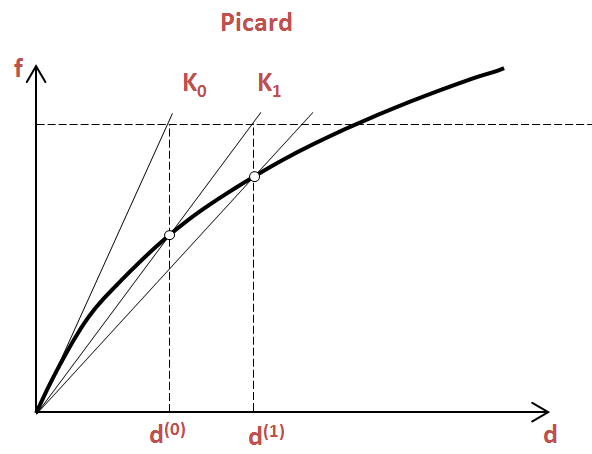
Note : This method requires that a 1D member is divided to at least four (4) finite elements. Usually, such division is adjusted automatically whenever Picard method is selected for calculation.