
|
||
|
|
||
The following table shows which cross-section types are supported for which type of analysis:
|
FRILO LTBII CSS |
SCIA Engineer CSS |
Eigenvalue analysis |
2nd Order analysis |
|---|---|---|---|
|
Double T |
I section from library |
x |
x |
|
|
Thin walled geometric I |
x |
x |
|
|
Sheet welded Iw |
x |
x |
|
Double T unequal |
IPY from library |
x |
x |
|
|
Thin walled geometric asymmetric I |
x |
x |
|
|
Haunched sections |
x |
x |
|
|
Welded I+Tl |
x |
x |
|
|
Sheet welded Iwn |
x |
x |
|
|
HAT Section IFBA, IFBB |
x |
x |
|
U cross section |
U section from library |
x |
x |
|
|
Thin walled geometric U |
x |
x |
|
Thin walled |
Cold formed from library |
x |
x |
|
|
Cold formed from graphical input |
x |
x |
|
Double T with top flange angle |
Welded I+2L |
x |
|
|
|
Sheet welded Iw+2L |
x |
|
|
Rectangle |
Full rectangular from library |
x |
|
|
|
Full rectangular from thin walled geometric |
x |
|
|
Static values double symmetric |
all other double symmetric CSS |
x |
|
|
Static values single symmetric |
all other single symmetric CSS |
x |
|
Remark: Haunched sections are replaced by equivalent asymmetric I sections, by ignoring the middle flanges.
The following picture illustrates the relation between the local coordinate system of SCIA Engineer and FriLo LTBII. Special attention is required for U sections due to the inversion of the y and z-axis.
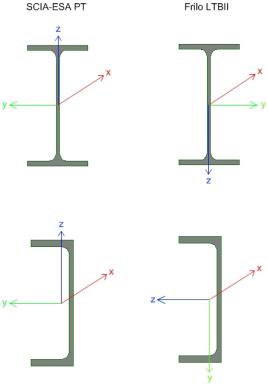
For more information, reference is made to Ref[2]