|
||
|
|
||
The plastic resistance of the web results from its yielding and from a progressive apparition of plastic yields line mechanism. The failure mode mechanism is divide into two main groups: the local and the global mechanism similarly to those proposed in Ref.[1] J.3.6.2 (5) & (6). A local mechanism means that the yield line is localized only in the compressive zone or in the tensile zone of the joint while global failure mode design the yields line pattern involves both in compressive and tensile zone. In the design model, it is assumed that prying action between end plate or the angle cleat doesn’t occur. This assumption is conflicting with assumptions made in Ref.[1]. This point is still under investigation but in most practical cases, it is reasonable to assume that no prying develops between components. The design resistance of the web in transverse compression or tension is finally defined as: FRd=min(Flocal,Fglobal).
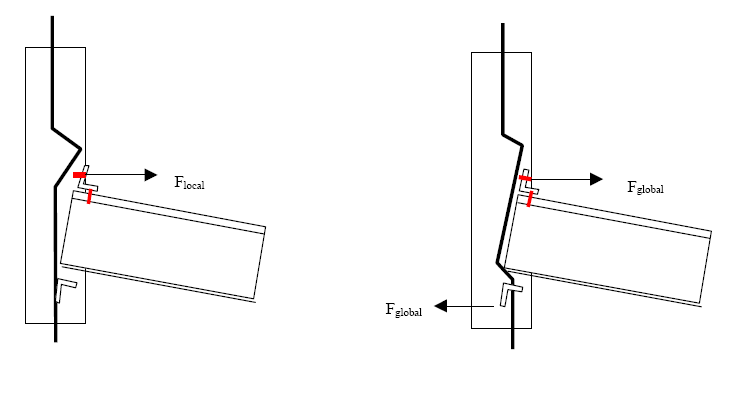
The moment carried out by the beam to the column web may be decomposed in a couple of forces F acting in the compressive and the tensile zone. It is assumed that these forces act on an area (compressive and tensile zone) defined in the plane of the column web. The design value of the moment resistance can be calculated as follows:

with
|
z |
the lever arm in the joint |
|
FRd |
the resistance of the weakest axis component in the minor axis joint |
Basic failure mechanisms are obtained by yields line method.. In the flexural mechanism, it is assumed that plastic moment is not reduced by the presence of shear forces perpendicular to the plane web. The plastic moment per unit length of yield line is given by:

where fy is the yield stress and tw the thickness of the column web.
In the local failure mode different local mechanisms of the column web are considered. The force F acts on a rigid rectangle. This rectangle is defined by the dimensions bxc (see figure). The weld perimeter rectangle around the beam flange or the loaded area around the bolt pattern defined the rigid rectangle. The yield pattern is localised in the compression or the tension zone. As result from this definition, the resistance force is evaluated in each rigid rectangle: one in the compression zone and one in the tension zone. This mechanism is associated to the smallest force FRd,local between the punching shear resistance and the combination of punching shear and bending resistance in the compression and the tension zone. Some adaptations and interpretations are needed to design a pinned connection.
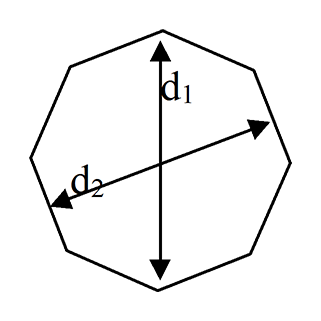
The resistance to punching depends on the loading case. For the loading case 1 the punching function of the punching perimeter 2(b+c). For the loading case 2, the punching perimeter of the column web depends on the diameter of the bolt heads (or nuts) and the number n of bolts respectively in the tension/compression zone. The resistance is given by:
 : loading case 1
 : loading case 2
with
|
twc |
the thickness of the column web |
|
fy |
the yield strength of the column web |
|
γM0 |
the partial safety factor of steel |
|
dm |
average diameter of the bolt head (see further) |
Combined flexural and punching shear mechanism takes also into account that the plastic moment per unit length of yield line is reduced by the presence of shear force.