|
||
|
|
||
This chapter is related to the Analysis of construction stages and Time dependent analysis.
Modules Construction stages and TDA can use all types of database cross-sections in SCIA Engineer. A new feature called "phased cross-section" has been introduced for those modules. Phased cross-sections consist of two or more parts, each of which can be of different material. Phased cross-sections allow for modelling of composite structures. The cross-section is built-up step-by-step starting by phase 1. Each phase of the cross-section is modelled by means of separate finite elements with eccentricity in the longitudinal direction. Therefore, stress redistribution between two different phases of cross-section will appear in TDA analysis due to creep and shrinkage of concrete. If any phase consists of more separate parts (of the same or different materials), only one finite element will be generated for that phase between two nodes of the FEM mesh. Sectional characteristic of individual parts will be transformed to one material. The generated finite element will have transformed cross-sectional characteristic. For that reason no stress redistribution can be expected in the analysis between individual parts of one phase.
Phased cross-sections can be created as a General cross-section. General cross-section can be defined by means of a polygon drawing or by conversion from other types of database cross-sections. Also some pre-defined bridge cross-sections can be defined as phased. Up to ten phases can be defined for one cross-section.
Detailed information on general cross-section module is given in chapter Cross-sections > General cross-section. The important limitation in SCIA Engineer is that only one phased cross-section can be defined for one 1D member! Therefore it is not possible to use the phased cross-section in the arbitrary beam (i.e. the 1D member consisting of several sections made of different cross-sections).
One important condition must be fulfilled when a phased general cross-section is created. The condition is clear from the following picture.
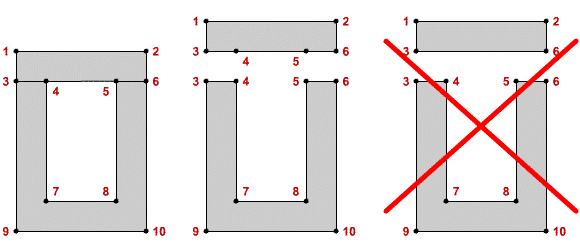
Example of a phased cross-section
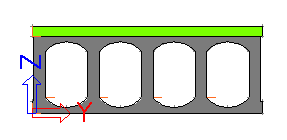
The following picture shows a hollow core floor slab [phase 1] (400 mm high) with a 50 mm topping [phase 2].
A beam with phased cross-section requires rather fine (finite element) mesh. This fine mesh is necessary to produce good and reliable results.
The size of finite elements for beams with a phased cross-section is determined by parameter Average size of cables, tendons, elements on subsoil from the FE Mesh Setup Dialogue.
It is recommended to use FEM analysis for the calculation of sectional characteristics of a phased cross-section. This can be done in the editing dialogue of a cross-section by ticking (selecting) the option FEM analysis. When this option is ON, the program starts a special engine to calculate the sectional characteristics.
The result of the analysis is shown in a separate dialogue.
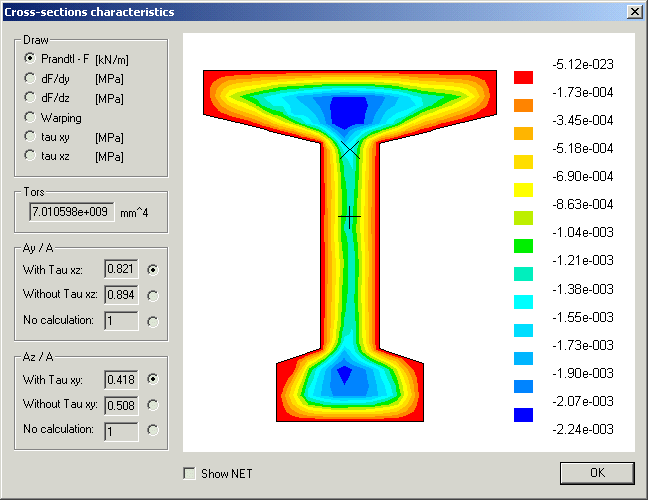
It is possible to view some results and also to select the way for the determination of shear-related parameters: Ay/A and Az/A (see the note below).
Note: It is up to the user to review the shear-related values and select the correct (or most correct) one manually.
The sectional characteristics are transformed to an ideal sectional characteristics.
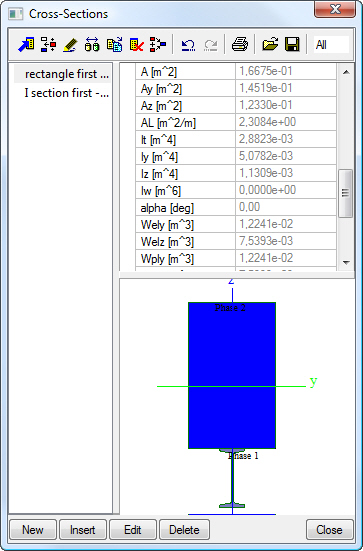
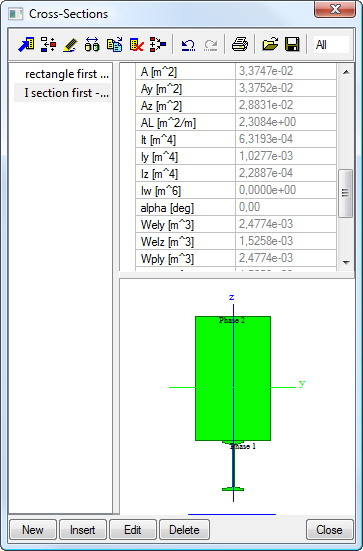
For phased cross-sections from the program library, the characteristics are related to the material of the first phase of the cross-section (i.e. the material of the part of the cross-section that forms the first phase).
For general cross-sections, the characteristics are related to the material of the first input part of the cross-section independently on phases.
Compare the two images below. The same general cross-section consisting of a concrete rectangular section and steel I section. In the first one, the rectangle was defined as the first part. In the second one, the I-section was defined as the first part.