
|
||
|
|
||
When a predefined load is applied, the real load intensity is not defined explicitly by a single value. Instead, some other data are input and the final intensity is calculated from them.
This may initiate a discussion, which value should be displayed on the screen:
the input data?
the final – calculated intensity value?
SCIA Engineer uses a compromise, allowing the user to select which value types should be displayed.
The adjustment may be made by means of appropriate View parameters. The tab Labels and descriptions contains groups Loads:
|
Display label |
Controls whether load labels will be shown or not. |
|
Name |
Shows the name of the load. |
|
Value |
Displays the load’s value. See Note below. |
|
Total value |
Displays total value of load. See Note below. |
Note: Items Value and Total value are significant for loads that are not defined directly by its force or moment impulse, but that were defined by means of a wind generator, load generator, or as a predefined load. For such loads, SCIA Engineer can display two different types of data. First, the input value (e.g. width load) can be shown, i.e. the value. Second, the calculated load per meter of length can be displayed (i.e. the total value).
The property dialogue gives enough space for additional information, and thus the input load width and calculated load intensity are shown – see value P.
Because the intensity is calculated from the input acting width, it is not editable.
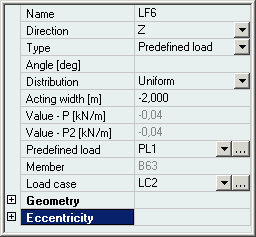
The preview window displays all the available information concerning the defined load.
The calculated load intensity is shown in column marked P. The input acting width is given in column marked W.
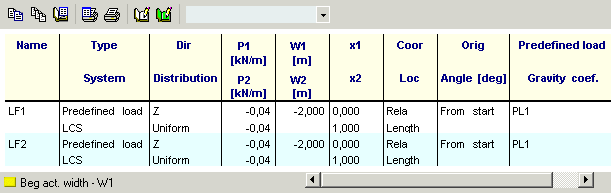
It is obvious that the calculation uses the pre-calculated load intensity as the factually applied load.
However strange it may seem on the first view, the sign convention used for predefined load is based on the same logic as for other load types.
Positive load acts in the direction of the appropriate axis.
Negative load acts against the direction of the appropriate axis.
What may seem strange is that the downward-oriented load (the weight of the predefined load "sandwich") must be defined as negative in order to really act "downwards". The strangeness is in the fact that acting width is input and it may seem unusual to specify a negative dimension. On the other hand, imagine a drawing showing loads of several types. With the convention applied, all the loads acting in the same direction will be of the same sign regardless of the type.