
Introduction
For calculating properties related to torsion the general theory makes a distinction between the following types of cross-sections, see Ref.[1]:
a) Thin-walled, open cross-sections

b) Thin-walled, closed cross-sections
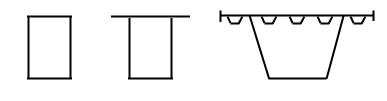
c) Arbitrary, thick-walled cross-sections
A cross-section is defined as thin-walled if, through a reduction to the profile centreline and the application of simplified theories, sufficiently exact calculation results are obtained. Ref.[1].
Within Scia-Engineer a thin-walled section is thus a section for which a centreline is available. To simplify the identification, the Shape Type (thin-walled or thick-walled) is shown in the properties of each cross-section.
In literature, for thin-walled, open sections analytical solutions are widely available. For thin-walled, closed (hollow) sections with a single opening analytical solutions are also available Ref.[6] however in case of multiple openings a statically indeterminate problem emerges which requires a large effort to solve analytically.
Therefore, within SCIA Engineer, a numerical 1D Finite Element Method is used to calculate the torsional properties of any thin-walled section. The main advantages of this method are that it applies to both open and closed sections and can be used for closed sections with any amount of openings.
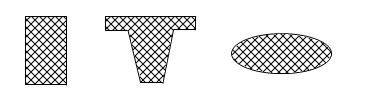
In literature, for thick-walled sections analytical solutions only exist for a few basic shapes such as rectangles, triangles and ellipses. Within SCIA Engineer, for thick-walled sections a numerical 2D Finite Element Method is used to provide an exact solution for any shape.
In addition, the 2D Finite Element Method can even be applied optionally to thin-walled sections.
The following table summarizes this approach:
|
Shape Type |
Method for Torsional Analysis |
|---|---|
|
Thin-walled open section |
|
|
Thin-walled closed section |
1D FEM (Optionally 2D FEM) |
|
Thick-walled section |
2D FEM |
The following chapters give an overview of both the 1D and 2D Finite Element Methods.