
Footfall analysis - Calculation
Introduction
This page describes the calculation procedure and the formulas used to evaluate footfall response according to the main design methods:
-
SCI P354 [1]
-
CCIP-016 [2]
-
AISC DG11[3]
For each method, both transient vibrations and resonant (steady-state) solutions are described.
Forced node and analysed node
Before looking at the formulas, it is important to distinguish between the two key concepts:
-
Forced node - e: the finite element node where the pedestrian excitation is applied. In practice, all nodes that lie within the area defined by the Footfall load are treated as forced nodes.
-
Analysed node - r: the finite element node where the vibration response is evaluated based on the selected design method.
Self excitation and full excitation
The relationship between the forced node and the analysed node defines the two excitation methods available in a footfall load case: Self Excitation and Full Excitation.
Self Excitation
In this method, the forced node is always the same as the analysed node. As a result, responses are calculated only at locations where the pedestrian excitation is directly applied.
For each walking frequency, the forced node is moved sequentially, and the response is determined only at that node according to the formulas described in the following chapters. This means that, for each fundamental footfall frequency, only one response value is available per node.
In the analysis results, each analysed node shows only the maximum response across all walking frequencies. These results are directly presented to the user in the Dynamic - detailed Footfall results. The tabular output also includes: the position of the analysed node, the maximum response value, the walking frequency at which it occurred, and the position of the forced node (which, in Self Excitation, is the same as the analysed node).

Full Excitation
In Full Excitation, the response is calculated at all nodes of the structure for each forced node. This means that every node is considered an analysed node.
For each walking frequency, the forced node is moved sequentially, and the response is calculated for every analysed node in the model. Consequently, each analysed node initially has as many response values as there are forced nodes. Only the maximum response and the position of the forced node that generated it are retained.
In the final analysis results, each analysed node shows only the maximum response across all walking frequencies. Again, these values are directly visible to the user in the Dynamic-detailed Footfall results, along with the tabular details: analysed node position, maximum response value, the walking frequency that caused it, and the position of the forced node that generated this response.

SCI P354
Transient vibrations
For transient vibration analysis, the vertical acceleration at the analysed node is calculated using:

where:
 - number of modes
 -frequency of the
  -th mode shape
 - critical damping ratio
 - vertical displacement of the
  -th mode at the forced node
 - vertical displacement of the
  -th mode at the analysed node
 - excitation force
 - modal mass of the
  -th mode shape (equal to 1, if the shapes are normalised to the mass)
 - weighting curve value corresponding to the
  -th mode frequency
Excitation force is calculated as:
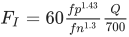
where :
 - pace frequency
 - static force exerted by an "average person". This value corresponds to the weight of the walker specified in the footfall load case, normally taken as 746 N, which is equivalent to a mass of 76 kg (assuming
  = 9.81 m/s²).
The RMS acceleration is determined using:

here,  is the step period, calculated as
  , where
  is the pace frequency.
In order to obtain the transient response, a dynamic time-history analysis was performed. The primary goal of the transient analysis is to obtain accelerations, which are then used to calculate the response factor. Consequently, accelerations are the only results directly available from the transient analysis; displacement and velocity are not computed. To obtain these additional results for each walking frequency, two further time-history analyses would be required, which would significantly increase the computational effort.
Resonant (steady-state) vibrations
As with the transient response, the standard provides only acceleration results for resonant analysis. It is important to select the correct combination method when performing the calculation. If the value is calculated without RMS, the factor 1/√2 is omitted from the formulas:
-
SOP-RMS

-
SRSS-RMS

where:
 - number of harmonic
 - excitation force for the
  -th harmonic,
  (
( is the Fourier coefficient from Footfall analysis coefficients)
 - dynamic magnification factor for accelerations
 - weighting curve value corresponding to the frequency of the
  -th harmonic.
The dynamic magnification factor is calculated as:
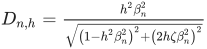
where :
 - harmonic number
 - frequency ratio
 - frequency corresponding to the first harmonic of the activity (fundamental frequency)
 - frequency of the
  -th mode shape
It is also necessary to consider whether the pedestrian remained on the structure long enough for the resonant response to reach its maximum. This is accounted for using the Resonance build-up factor  , which multiplies the resonant acceleration:

The standard procedure directly provides acceleration values, from which displacement and velocity are derived. These results are available in the Dynamic-Detailed.
Response factor
The dimensionless response factor at analysed node r is defined as:
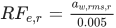
where:

In the Dynamic Detailed results, the values for the transient, resonant, and overall maximum responses are denoted as  .
.
In the load case settings, several combination methods can be selected, allowing the user to calculate values using alternative combinations if needed. For a calculation compliant with the design method, SRSS-RMS must be chosen.
Units
The response factor is linked to the “Safety factor” unit in the “Others” section.
Number of events - vibration dose value (VDV)
Unlike continuous vibration limits, which are intentionally conservative, pedestrian-induced vibrations are intermittent and only occur when someone is actually walking. The Vibration Dose Value (VDV) method accounts for this by allowing higher vibration responses for short periods of time, provided they do not happen too often. In other words, it is not a problem if the floor vibrates a little more than the continuous limit for a brief moment, as long as such peaks remain occasional. Acceptability is therefore assessed not only by the vibration level at a given instant but also by how frequently the walking activity is repeated over the exposure period.
From the VDV formulation, the number of allowable events can be calculated. This represents how many times a walking activity of duration can take place within the reference period (typically 16 h day or 8 h night) without exceeding the acceptable VDV limit. If the actual number of walking events is lower than  , the vibration response can be considered acceptable even if instantaneous levels are above the continuous vibration thresholds. The value of number of events is determined directly from the VDV equation given below.
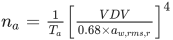
where:
 - target vibration dose value, specified in the footfall load case.
 - duration of the activity, calculated as the length of the walking path divided by the walking speed (these quantities are described in the Resonance build-up factor)
 - frequency weighted RMS acceleration
In the load case settings, several combination methods can be selected, allowing the user to calculate values using alternative combinations if needed. For a calculation compliant with the design method, SRSS-RMS must be chosen.
Units
The number of event is linked to the “VDV - vibration dose value” unit in the “Dynamics” section.
CCIP-016
Transient vibrations
For transient vibration analysis, the vertical velocity at the analysed node is calculated using:

where:
 - vertical displacement of the
  -th mode at the forced node
 - vertical displacement of the
  -th mode at the analysed node
 - critical damping ratio
 -frequency of the
  -th mode shape
 - impulse load of a footfall
 - modal mass of the
  -th mode shape (equal to 1, if the shapes are normalised to the mass)
 - time
The impulse load is calculated as:
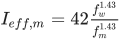
where  is the walking frequency.
The RMS response can be obtained from the resulting velocity time history over a single footfall period:

here,  is the step period, calculated as
 , where
  is the pace frequency.
In order to obtain the transient response, a dynamic time-history analysis was performed. The primary goal of the transient analysis is to obtain velocities, which are then used to calculate the response factor. Consequently, velocities are the only results directly available from the transient analysis; displacement and accelerations are not computed. To obtain these additional results for each walking frequency, two further time-history analyses would be required, which would significantly increase the computational effort.
Transient vibrations - response factor
For transient response, the response factor is calculated from the RMS velocity as:

here,  depends on the fundamental frequency of the structure (the frequency corresponding to the largest coefficient in the summation for transient response). Specifically:
-
If

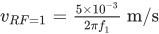
-
If


Resonant (steady-state) vibrations
For resonant vibrations, the real and imaginary parts of acceleration are calculated using:


where:
 - harmonic number
 -frequency of the
  -th mode shape
 - harmonic forcing frequency (
 )
)
 - excitation force for the
  -th harmonic,
 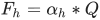 (
( is the Fourier coefficient from Footfall analysis coefficients and
  is the static weight of the walker)
 - correction factor, described here Resonance build-up factor
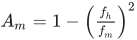 and
and 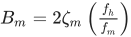 - parameters
The total acceleration response to a harmonic force,  , is obtained by summing the real and imaginary responses over all modes and computing the magnitude:

The standard procedure directly provides acceleration values, from which displacement and velocity are derived. These results are available in the Dynamic-Detailed.
Resonant (steady-state) vibrations - response factor
For each harmonic force  , the response factor
  is calculated based on the known acceleration
  using:
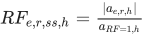
here, depends on the harmonic forcing frequency. The response factor is categorized according to the frequency range:
-
If

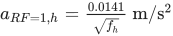
-
If


-
If


The overall response factor  is then obtained by combining the response factors
  for each of the four harmonics.

In the load case settings, several combination methods can be selected, allowing the user to calculate values using alternative combinations if needed. For a calculation compliant with the design method, SRSS must be chosen.
Response factor
The maximum response factor (overall) is determined as:

In the Dynamic Detailed results, the values for the transient, resonant, and overall maximum responses are denoted as  .
.
Units
The response factor is linked to the “Safety factor” unit in the “Others” section.
AISC DG11
Transient vibrations
For transient vibration analysis, the vertical acceleration at the analysed node is calculated from the  -th mode shape using:

where:
 - frequency of mode
 -
-  -th mass-normalized shape value at the footstep
 -
-  -th mass-normalized shape value at the affected occupant
 - effective impulse for
  -th mode
 - viscous damping ratio
 - footstep period, calculated as
  , where
  is the pace frequency.
The effective impulse is calculate as:
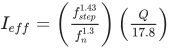
where:
 - is the step frequency
 - bodyweight in lb
The RMS acceleration is determined using:

here, is the step period, calculated as
  .
.
In order to obtain the transient response, a dynamic time-history analysis was performed. The primary goal of the transient analysis is to obtain accelerations, which are then used to calculate the response factor. Consequently, accelerations are the only results directly available from the transient analysis; displacement and velocity are not computed. To obtain these additional results for each walking frequency, two further time-history analyses would be required, which would significantly increase the computational effort.
Resonant (steady-state) vibrations
Similar to the transient response case, the standard provides acceleration results only for the resonant analysis. The calculation should be performed using the appropriate combination method, see the following equation:

where:
 - number of harmonic
 - harmonic number
 - excitation force for the
  -th harmonic,
  (
( is the Fourier coefficient from Footfall analysis coefficients)
 - modal mass of the
  -th mode shape (equal to 1, if the shapes are normalised to the mass)
 - dynamic magnification factor for accelerations calculated as:
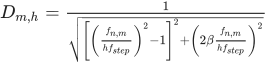
As in previous design methods, it is also necessary to consider whether the pedestrian remained on the structure long enough for the resonant response to reach its maximum. This is accounted for using the Resonance build-up factor  , which multiplies the resonant acceleration:

The standard procedure directly provides acceleration values, from which displacement and velocity are derived. These results are available in the Dynamic-Detailed.
Peak acceleration
Peak acceleration is analogous to the response factor used in other design methods. It is defined either as a percentage or as a dimensionless ratio, representing the ratio of the calculated acceleration to the gravitational acceleration. This value is then compared to the relevant limits to assess whether the structure meets the required performance or comfort criteria. The maximum value is determined as:

In the Dynamic Detailed results, the values for the transient, resonant, and overall maximum responses are denoted as  .
.
In the load case settings, several combination methods can be selected, allowing the user to calculate values using alternative combinations if needed. For a calculation compliant with the design method, SRSS-RMS must be chosen.
Units
The peak acceleration is linked to the “Ratio” unit in the “Others” section.
References
[1] Smith, A.L., Hicks, S.J. and Devine, P.J. (2009), Design of Floors for Vibration: A New Approach (Revised Edition, February 2009), The Steel Construction Institute, Silwood Park, Ascot, Berkshire, England.
[2] Willford, M. and Young, P. (2006), A Design Guide for Footfall Induced Vibration of Structures: A Tool for Designers to Engineer the Footfall Vibration Characteristics of Buildings or Bridges, CCIP-016, Concrete Centre, Camberley, UK
[3] Murray, T.M., Allen, D.E., Ungar, E.E. and Davis, D.B. (2016), Design Guide 11: Vibrations of Steel-Framed Structural Systems Due to Human Activity (Second Edition), American Institute of Steel Construction.