
|
||
|
|
||
In normal building structures, torsion generally arises as a secondary effect, and specific calculations are not necessary. Torsional cracking is generally adequately controlled by reinforcement provided to resist shear. Even when torsion occurs, it rarely controls the basic sizing of the members, and torsion check is often a check calculation after the members have been checked for flexure. In some cases, the loading that causes the maximum torsional moment may not be same that induces the maximum flexural effect. In some cases, reinforcement provided for flexure and the other forces may prove adequate to resist torsion.
The torsion check is commonly based on the theory of the concrete truss-model too. In this theory a virtual truss-model is imagined in a concrete beam. This truss-model has a set of vertical (or slightly diagonal), horizontal and diagonal members. The vertical bars are considered to be the stirrups; the horizontal bars are the main reinforcement and the diagonal bars are the concrete struts.
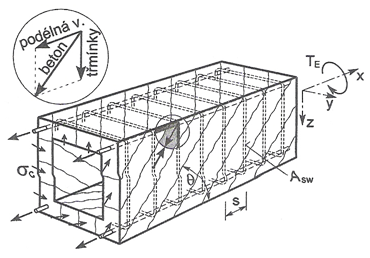
There are the following assumptions:
With the following limitations: